It's never been less worth it to upgrade to a new iPhone—or any brand new flagship phone, really—because we're increasingly paying more for gadgets that don't fix the problems that phones actually have. Maybe that's why one of the rumors circulating ahead of this fall's inevitable revamp isn't even about the phone: it's about the charger it comes with, one that could make charging faster.
Rumors started on the Chinese social network Weibo that the next generation of iPhones will come with a new 18W, USB-C charger packed in, something much more in line with the kinds of chargers that currently come with most Android phones and capable of delivering more juice than the 5W chargers Apple's been using for years. These rumors only sound more plausible in the light that Apple has dropped the price of its USB Type-C-to-Lightning cablesthat would be required to use the new wall warts.
What that actually means is quick charging, a feature that current iPhones technically supportbut which the 5W chargers they were packaged with do not. Quick charging is nothing new, and has been a selling point of various Android phones, often thanks to the Qualcomm chips they share, which do the technical work of intelligently routing the increased power from a high-watt charger in a way that makes a battery charge quicker without overheating. Apple's inclusion of a higher-watt charger would bring it up to par on this front, and help do something to ease low-battery anxiety in a world where no company seems interested in making a phone with a meaningfully long battery life.
While a pack-in charger capable of quick charging would certainly be a bonus, it'd also be a silly reason to upgrade your whole phone. If you've already got an iPhone 8, 8 Plus, or X, you can get get a faster charge just by updating your cable and charger. A good bet is this Anker USB-C charger and Apple's official, now discounted USB-C-to-Lightning cable which both fared well in some extensive testing by Gizmodo.
Your phone may never comfortably last more than a day, two at the most, but being able to top off quickly is at least a small comfort.
The six-time Emmy nominee and two-time Critics' Choice Award winner reflects on why her agents fired her after she agreed to play Joan, how she feels about all the attention paid to her figure and why she decided to follow a period drama with a contemporary network dramedy
"I love television, so I was never against going on to another series," says the actress Christina Hendricks, who is best known for playing Joan Holloway (later Joan Harris), a Madison Avenue advertising agency’s office manager who claws her way up the corporate food-chain over the course of seven seasons on AMC’s landmark drama series Mad Men, as we sit down at the offices of The Hollywood Reporter to record an episode of THR's 'Awards Chatter' podcast. The 42-year-old, whose work on that show garnered her six Emmy nominations for best supporting actress in a drama series and two Critics' Choice Award nominations — and wins — in that same category, emphasizes, "I just wanted it to be the right one."
Mad Men aired its final episode on May 17, 2015. Less than three years later, on Feb. 26, 2018, Hendricks began starring in another — albeit very different — series, NBC’s Good Girls, as one of three suburban Detroit housewives who try to extricate themselves from desperate financial straits by teaming together to rob a grocery store, only to find themselves in hotter water than ever. "When this opportunity came up," she says, "I had to ask, 'Do I want to do this every day for potentially seven years?' And I looked at these two other women [costars Retta and Mae Whitman], and this writing and this tone, and it was so different. I loved the balance of the drama and the comedy, and being able to stretch my muscles or whatever, and play in comedy alongside the drama, which I would say most people know me for. And I thought, 'That would be fun to do every day.'"
Airtel has launched a new recharge pack worth Rs. 449 for its subscribers in India. With the all-new plan, Airtel is directly countering Reliance Jio's prepaid recharge plan priced at Rs. 448. This Airtel recharge is offering 2GB of data per day and is available to Airtel prepaid subscribers. The Rs. 449 Airtel recharge offer comes with a total of 140GB of 3G/ 4G data for a period of 70 days with a daily FUP limit of 2GB data. As per Airtel's website, this prepaid pack also offers unlimited local, STD and roaming voice calls. 100 local and STD free SMSes are also bundled with this plan. The validity of the plan is 70 days. Jio, on the other hand, offers 2GB of high-speed 4G per day data for a period of 84 days.Interestingly, Airtel already has a prepaid recharge plan priced at Rs. 448 that offers 1.4GB of per day 3G/4G data for a period of 82 days. However, this plan comes with unlimited calling and free SMS messages.
Jio has largely changed the telecom industry, compelling all major operators to offer high-speed data at throwaway prices. Its closest offer to the Airtel plan is the Rs. 448 recharge pack. It comes with 2GB of 4G data per day for a validity period of 84 days, that is, 168GB of data.
Other recent offers from Airtel include a new prepaid plan priced at Rs. 558. Under this Rs. 558 pack, the mobile operator offers a total of 246GB of 3G/ 4G data for a period of 82 days with a daily FUP limit of 3GB data. Notably, this plan also comes with unlimited local, STD and roaming voice calls and 100 free SMS messages are also offered with this plan.
Airtel had recently introduced a new prepaid recharge plan priced at Rs. 149 and it offers 1GB of per day data for a period of 28 days. Free Hello Tunes, Unlimited calling and SMS benefits are also bundled with this prepaid pack, as mentioned on the official website of Airtel.
With 20.5 percent market share, Samsung led the global smartphone sales in the first quarter of 2018 but suffered a dip in its sales globally from the same quarter last year, Gartner said on Tuesday.
Samsung had 20.8 percent market share in the first quarter of 2017. In Q1 2018, its 20.5 percent share was followed by Apple (14.1 percent), Huawei (10.5 percent), Xiaomi (7.4 percent), and Oppo (7.3 percent) respectively.
According to Gartner, global sales of smartphones to end users returned to growth in the first quarter with a 1.3 percent increase over the same period last year.
Nearly 384 million smartphones were sold in the first quarter of 2018, representing 84 percent of total mobile phones sold.
Xiaomi was the clear winner of the first quarter, achieving a growth of 124 percent year on year, the report showed. A refreshed portfolio of smartphones and aggressive pricing strategy helped Xiaomi hold the fourth position in the first quarter of 2018.
"This strategy led Xiaomi to achieve 330 percent growth in the Emerging Asia/Pacific region," said Anshul Gupta, Research Director at Gartner.
Samsung's smartphone growth rate will remain under pressure through 2018, with Chinese brand's growing dominance and expansion into Europe and Latin America markets, according to Gartner.
Samsung is challenged to raise the average selling price (ASP) of its smartphones, while facing increasing competition from Chinese brands that are taking more market share, the research indicated.
Apple's smartphone unit sales returned to growth in the first quarter of 2018, with an increase of four percent year on year.
"Even though demand for Apple's iPhone X exceeded that of iPhone 8 and iPhone 8 Plus, the vendor struggled to drive significant smartphone replacements, which led to slower-than-expected growth in the first quarter of 2018," Gupta noted.
"With its exclusive focus on premium smartphones, Apple needs to significantly raise the overall experience of its next-generation iPhones to trigger replacements and lead to solid growth in the near future," he added.
Huawei's refreshed smartphone portfolio helped strengthen its no. 3 global smartphone vendor position.
"Achieving 18.3 percent growth in the first quarter of 2018 helped Huawei close the gap with Apple," Gupta pointed out.
The results showed that Samsung's mid-tier smartphones faced continued competition from Chinese brands which led to its unit sales contraction year on year.
HP reported better-than-expected quarterly revenue and raised its full-year profit forecast on Tuesday, helped by strong demand for its notebooks and desktops.
The company also named Steve Fieler as its chief financial officer, succeeding 32-year HP veteran Cathie Lesjak.
Fieler, whose appointment is effective July 1, currently leads HP Inc's treasury and corporate finance functions. Lesjak will step into the role of interim chief operating officer.
Shares of HP, formed out of the 2015 split of Hewlett-Packard Co, were marginally up in extended trading.
The company raised its forecast for full-year adjusted profit to between $1.97 (roughly Rs. 134) and $2.02 (roughly Rs. 137) per share, from $1.90 (roughly Rs. 129) to $2.00 (roughly Rs. 136). Analysts on average were expecting $1.97 (roughly Rs. 134), according to Thomson Reuters.
HP Inc's personal systems business, which includes notebooks and desktops and accounts for more than 60 percent of total revenue, rose 14.5 percent to $8.76 billion (roughly Rs. 5,90,00 crores) in the second quarter. Analysts on average had expected $8.28 billion (roughly Rs. 5,60,000 crores).
The Palo Alto, California-based company had the top position in worldwide PC shipments in the first calendar quarter of 2018 with a 22.6 percent market share, according to research firm International Data Corp's (IDC) data.
IDC analysts have said demand for premium notebooks in both the consumer and commercial segments have helped major PC vendors to retain better margins and garner buyer interest.
HP Inc, which completed the acquisition of Samsung Electronics' printer business last year, said revenue from its printing business rose 10.9 percent to $5.24 billion, above analysts' estimate of $5.13 billion.
Net earnings jumped 89.3 percent to $1.06 billion, or 64 cents per share, in the quarter ended April 30, mostly helped by a one-time tax benefit of $975 million.
Excluding items, the company earned 48 cents per share, in line with Wall Street estimates.
Revenue rose 13.1 percent to $14 billion, above analysts' average estimate of $13.57 billion.
A proposed class-action lawsuit alleging Facebook's ad placement tools facilitate discrimination against older job-seekers has been expanded to identify additional companies, further widening the latest front in claims that candidates are being filtered out by gender, geography, race and age.
"When Facebook's own algorithm disproportionately directs ads to younger workers at the exclusion of older workers, Facebook and the advertisers who are using Facebook as an agent to send their advertisements are engaging in disparate treatment," a communications union alleged in the amended complaint- citing a legal test for employment discrimination-filed Tuesday in San Francisco federal court. The union added claims under California's fair employment and unfair competition statutes to the lawsuit, which was initially filed in December.
The Communications Workers of America is suing on behalf of union members and other job seekers who allegedly missed out on employment opportunities because companies used Facebook's ad tools to target people of other ages. The original filing named defendants are Amazon.com Inc., Cox Media Group, Cox Communications Inc. and T-Mobile, as well as what the union estimates to be hundreds of employers and employment agencies who used Facebook's tools to filter out older job hunters when seeking to fill positions.
The amended filing adds Ikea, Enterprise Rent-A-Car and the University of Maryland Medical System to its list of companies who allegedly used Facebook's tools to filter by age. Those three entities, as well as Facebook, aren't named defendants in the lawsuit.
Cox Communications declined to comment. Cox Media, Amazon, T-Mobile, Facebook, and the companies added to the amended complaint didn't immediately provide comment in response to inquiries made before regular business hours.
The union alleged in its amended lawsuit that Facebook also uses age-filtering in ads intended to find its own new employees. In January, the union filed an Equal Employment Opportunity Commission complaint about the alleged practice, according to a copy obtained by Bloomberg News. The CWA says it has filed similar claims against dozens of companies, and that the agency has asked those employers, and Facebook, to respond to the allegations. An EEOC spokeswoman declined to confirm or deny the existence of any complaints.
"It's important that the EEOC engages in a rigorous and comprehensive investigation of Facebook, since Facebook is the largest employment agency in the history of the world," Peter Romer-Friedman, a lawyer for the union, said in an interview.
In a December statement, Facebook Vice President of Advertisements Rob Goldman said "Facebook tailors our employment ads by audience" and "we completely reject the allegation that these advertisements are discriminatory." Regarding other companies, he said the company helps educate advertisers about their legal responsibilities and requires them to certify they are complying with the law.
Comparing age-targeted employment ads to ads placed in magazines or on TV shows favored by people of certain ages, Goldman wrote that, "Used responsibly, age-based targeting for employment purposes is an accepted industry practice and for good reason: it helps employers recruit and people of all ages find work."
The debate over targeted online advertising has drawn the attention of the Senate Special Committee on Aging, whose Republican and Democratic leaders jointly requested Facebook hand over information, including how many jobs have been advertised on Facebook over the past five years using age-specific ads, and what age criteria were used.
The CWA litigation may be a sign of things to come as hiring increasingly migrates onto internet platforms, said Ifeoma Ajunwa, a lawyer and sociologist who teaches at Cornell University's Industrial and Labor Relations School.
"The same types of discrimination issues that you would see in traditional hiring are now just being transferred over to the platforms," she said. "You could even argue that the new way, using platforms, is worse, because it's more solidified-there's no wiggle room, there's no accidental meetings."
In the amended complaint, CWA alleged that Facebook encourages advertisers to exclude some job-seekers by providing both age filters and regularly updated data on how ads perform among different age groups. The union also claims Facebook targets employment ads to "lookalike audiences" chosen for their demographic similarity to the people who already have a job at the same company, a practice which further marginalizes older job-seekers.
The union also alleged that, "in addition to encouraging and allowing employers and employment agencies to restrict which Facebook users will receive job ads based on their age," Facebook's algorithm further factors in age when determining which users among the population chosen by the advertiser will actually see the ad.
Federal law offers immunity for internet platforms acting as "passive conduits" of information.
In a Q&A posted in its online Help Center, Facebook tells users that, to "decide which ads to show you," it uses factors including information from user accounts such as location, gender and age.
How much discretion Facebook uses in serving up ads based on user age could be a crucial question in the EEOC complaint and the CWA lawsuit. The 1996 Communications Decency Act offers internet companies a shield from being held liable "as the publisher or speaker" of content placed on their site by other parties, such as comments left in public forums. That law could be a potential defense against the union's EEOC allegations, or in resisting efforts to force disclosures about how advertisements were targeted, and what role Facebook played, if any.
The U.S. Court of Appeals in San Francisco has previously ruled that, while the law offers immunity for platforms acting as "passive conduits," it doesn't shield a company which "contributes materially to the alleged illegality of the conduct." The circuit, which subsumes the CWA lawsuit's venue, ruled in a 2008 case that the Communications Decency Act wouldn't prevent liability for a company that specifically offered prospective roommates drop-down menus from which to declare preferences based on race.
Still, courts have generally interpreted the CDA's protections very broadly, said University of Miami law professor Mary Anne Franks, including in a series of rulings siding with the website Backpage.com when it was sued for allegedly facilitating sex trafficking. Those rulings spurred congressional passage of a law meant to quash Backpage's defense against the CDA. While that move to carve out an exception to the law's protections of internet companies was tailored to punish alleged sex trafficking, Franks says it could contribute to a climate of greater skepticism about the breadth of the law's protections, which could also influence judicial rulings.
Romer-Friedman said the plaintiffs' new allegations would make it that much harder for Facebook to use the CDA as a shield.
"To the extent that Facebook's algorithm is using age to determine who will get what ads, and that results in older workers being excluded," he said, "those decisions are Facebook's decisions."
Honor 7C and Honor 7A were launched in India last week, and the two budget smartphones from Huawei's sub-brand Honor were made exclusive to Amazon and Flipkart respectively. While the Honor 7A went on sale on Flipkart on May 29, the Honor 7C is set to go on sale for the first time on Amazon today, at 12pm IST. The Honor 7C will be sold on Amazon India in two variants, and the e-commerce site has detailed the launch offers for the smartphone.
Honor 7C price in India, launch offers
The 3GB RAM/ 32GB storage variant of the Honor 7C has been priced at Rs. 9,999, while the Honor 7C's 4GB RAM/ 64GB storage variant is priced at Rs. 11,999. The Honor 7C will be made available in three colour variants - Black, Gold, and Blue. Launch offers include no cost EMI options up to 9 months, and Rs. 2,200 cashback and 100GB additional 4G data for Reliance Jio subscribers.
Honor 7C specifications
The Honor 7C was first launched in China in March and it runs on EMUI 8.0 based on Android 8.0 Oreo. The dual-SIM (Nano) device sports a 5.99-inch HD+ (720x1440 pixels) IPS LCD display with an 18:9 aspect ratio. It is powered by an octa-core Qualcomm Snapdragon 450 SoC coupled with 3GB or 4GB of RAM.
Notably, the Honor 7C bears the same dual rear camera setup as the Honor 7A with a primary 13-megapixel sensor and a secondary 2-megapixel sensor. On the front, it bears an 8-megapixel camera with an f/2.0 aperture and a soft selfie light. It features 32GB or 64GB of inbuilt storage expandable via microSD card (up to 256GB) with a dedicated slot.
Connectivity options include 4G VoLTE, Wi-Fi 802.11 b/g/n with hotspot, Bluetooth v4.2, GPS/ A-GPS, Micro-USB, and 3.5mm headphone jack. Sensors onboard the Honor 7C include accelerometer, ambient light sensor, and proximity sensor. It features a fingerprint sensor on the rear panel, and a Face Unlock feature. The Honor 7C measures 158.3x76.7x7.8mm and weighs 164 grams. It is powered by a 3000mAh battery.
Honor 7C features
Huawei's Honor brand if offering some special features for the Honor 7C, including Huawei Histen's 3D sound effects. Also new is a Ride Mode, similar to Samsung's S bike mode. Honor has also included a Party Mode, letting users connect several phones to a single output. The company is also touting Paytm fingerprint single touch access.
You can run from Boston Dynamics' humanoid robot Atlas, but it wouldn't do you any good — the robot can run after you.
In a video shared to YouTube yesterday (May 10) by the robot maker, the uncannily human-like Atlas demonstrates running ability that is eerily reminiscent of a person's. The robot jogs methodically across an expanse of grass, against a backdrop of trees punctuated by a few isolated buildings.
The scene is almost peaceful and idyllic, except for the pervasive whirring and clanking of Atlas' motors, gears and joints, and the sense of growing unease that comes with witnessing the inexorable approach of our future robot overlords. [Super-Intelligent Machines: 7 Robotic Futures]
Boston Dynamics poses the video's title as a question — "Getting some air, Atlas?" — as though Atlas had somehow unexpectedly taken himself outside for a run, on a whim.
The robot, described as "the world's most dynamic humanoid" on the Boston Dynamics website, runs at a slow-but-steady pace over grass, up a slight incline to another field, and then stops in front of a log. Atlas steadies himself, bends his "knees," raises his "arms" and nimbly hops over the log, landing without a wobble. It's an impressive display — and so much like the actions of a person that it's also a little unsettlingThis isn't the first time that Atlas' antics have gone viral. Atlas appeared in a video compilation posted to YouTube on Feb. 23, 2016, that showed the robot walking flat-footed through a snow-covered forest, stacking boxes on shelves and recovering its balance after a Boston Dynamics employee pushed the bot with a hockey stick.
Another video, released on Nov. 16, 2017, showed Atlas hopping on and off blocks and even performing a backflip.
But this is the first footage to show Atlas "free running" outdoors. This new video may represent a test of the robot's balance and ability to navigate in a landscape that is more uneven than a warehouse floor, as the robot's sensors are intended to allow it to move smoothly over "rough terrain" and to quickly recover if it stumbles or falls over, according to the Boston Dynamics website.
A billion operations per second isn't cool. Know what's cool? A million billion operations per second.
That's the promise of a new computing technique that uses laser-light pulses to make a prototype of the fundamental unit of computing, called a bit, that could switch between its on and off, or "1" and "0" states, 1 quadrillion times per second. That's about 1 million times faster than the bits in modern computers.
Conventional computers (everything from your calculator to the smartphone or laptop you're using to read this) think in terms of 1s and 0s. Everything they do, from solving math problems, to representing the world of a video game, amounts to a very elaborate collection of 1-or-0, yes-or-no operations. And a typical computer in 2018 can use silicon bits to perform more or less 1 billion of those operations per second. [Science Fact or Fiction? The Plausibility of 10 Sci-Fi Concepts]
In this experiment, the researchers pulsed infrared laser light on honeycomb-shaped lattices of tungsten and selenium, allowing the silicon chip to switch from "1" to "0" states just like a normal computer processor — only a million times faster, according to the study, which was published in Nature on May 2.
That's a trick of how electrons behave in that honeycomb lattice.
In most molecules, the electrons in orbit around them can jump into several different quantum states, or "pseudospins," when they get excited. A good way to imagine these states is as different, looping racetracks around the molecule itself. (Researchers call these tracks "valleys," and the manipulation of these spins "valleytronics.")
When unexcited, the electron might stay close to the molecule, turning in lazy circles. But excite that electron, perhaps with a flash of light, and it will need to go burn off some energy on one of the outer tracks.
The tungsten-selenium lattice has just two tracks around it for excited electrons to enter. Flash the lattice with one orientation of infrared light, and the electron will jump onto the first track. Flash it with a different orientation of infrared light, and the electron will jump onto the other track. A computer could, in theory, treat those tracks as 1s and 0s. When there's an electron on track 1, that's a 1. When it's on track 0, that's a 0.
Crucially, those tracks (or valleys) are sort of close together, and the electrons don't need to run on them very long before losing energy. Pulse the lattice with infrared light type one, and an electron will jump onto track 1, but it will only circle it for "a few femtoseconds," according to the paper, before returning to its unexcited state in the orbitals closer to the nucleus. A femtosecond is one thousand million millionth of a second, not even long enough for a beam of light to cross a single red blood cell.
So, the electrons don't stay on the track long, but once they're on a track, additional pulses of light will knock them back and forth between the two tracks before they have a chance to fall back into an unexcited state. That back-and-forth jostling, 1-0-0-1-0-1-1-0-0-0-1 — over and over in incredibly quick flashes — is the stuff of computing. But in this sort of material, the researchers showed, it could happen much faster than in contemporary chips.
The researchers also raised the possibility that their lattice could be used for quantum computing at room temperature. That's a kind of holy grail for quantum computing, since most existing quantum computers require researchers to first cool their quantum bits down to near absolute zero, the coldest possible temperature. The researchers showed that it's theoretically possible to excite the electrons in this lattice to "superpositions" of the 1 and 0 tracks — or ambiguous states of being kind-of-sort-of fuzzily on both tracks at the same time — that are necessary for quantum-computing calculations.
"In the long run, we see a realistic chance of introducing quantum information devices that perform operations faster than a single oscillation of a lightwave," study lead author Rupert Huber, professor of physics at the University of Regensburg in Germany, said in a statement. However, the researchers didn't actually perform any quantum operations this way, so the idea of a room- temperature quantum computer is still entirely theoretical. And in fact, the classical (regular-type) operations the researchers did perform on their lattice were just meaningless, back-and-forth, 1-and-0 switching. The lattice still hasn't been used to calculate anything. Thus, researchers still have to show that it can be used in a practical computer.
Still, the experiment could open the door to ultrafast conventional computing — and perhaps even quantum computing — in situations that were impossible to achieve until now.
Artificial intelligence is getting very good at identifying things: show it a million pictures, and it can tell you with uncanny accuracy which ones depict a pedestrian crossing a street. But AI is hopeless at generating images of pedestrians by itself. If it could do that, it would be able to create gobs of realistic but synthetic pictures depicting pedestrians in various settings, which a self-driving car could use to train itself without ever going out on the road.
The problem is, creating something entirely new requires imagination—and until now that has perplexed AIs.
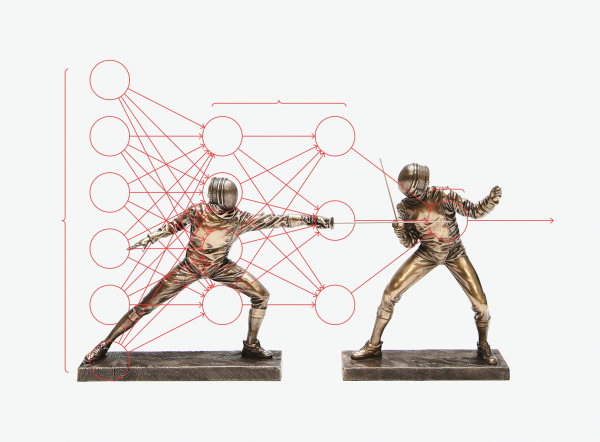
The solution first occurred to Ian Goodfellow, then a PhD student at the University of Montreal, during an academic argument in a bar in 2014. The approach, known as a generative adversarial network, or GAN, takes two neural networks—the simplified mathematical models of the human brain that underpin most modern machine learning—and pits them against each other in a digital cat-and-mouse game.
Both networks are trained on the same data set. One, known as the generator, is tasked with creating variations on images it’s already seen—perhaps a picture of a pedestrian with an extra arm. The second, known as the discriminator, is asked to identify whether the example it sees is like the images it has been trained on or a fake produced by the generator—basically, is that three-armed person likely to be real?
Over time, the generator can become so good at producing images that the discriminator can’t spot fakes. Essentially, the generator has been taught to recognize, and then create, realistic-looking images of pedestrians.
The technology has become one of the most promising advances in AI in the past decade, able to help machines produce results that fool even humans.
GANs have been put to use creating realistic-sounding speech and photorealistic fake imagery. In one compelling example, researchers from chipmaker Nvidia primed a GAN with celebrity photographs to create hundreds of credible faces of people who don’t exist. Another research group made not-unconvincing fake paintings that look like the works of van Gogh. Pushed further, GANs can reimagine images in different ways—making a sunny road appear snowy, or turning horses into zebras.
The results aren’t always perfect: GANs can conjure up bicycles with two sets of handlebars, say, or faces with eyebrows in the wrong place. But because the images and sounds are often startlingly realistic, some experts believe there’s a sense in which GANs are beginning to understand the underlying structure of the world they see and hear. And that means AI may gain, along with a sense of imagination, a more independent ability to make sense of what it sees in the world. —Jamie Condliffe
Insects may seem like mere pests, but their physical abilities are still beyond even the most sophisticated robots. Engineers at the University of Washington have taken important first steps towards filling that gap by creating a robotic fly that has taken its first independent flaps.
With the right size and speed, robotic insects could do anything from surveying crop growth to inspecting pipes for microscopic leaks. But the electronics needed for this type of sophisticated device have kept robotic insects tethered or weighed down.
“Before now, the concept of wireless insect-sized flying robots was science fiction. Would we ever be able to make them work without needing a wire? Our new wireless RoboFly shows they’re much closer to real life,” says co-author Sawyer Fuller, an assistant professor in the UW Department of Mechanical Engineering in a press statement.
From an engineering standpoint, the greatest difficulty for Fuller's team was flapping wings. If you've ever tried moving your arms up and down rapidly, it's easy to see what a power-draining process flapping can be. Power sources and controllers are too bulky to fit into the fly. It's a fact that kept Fuller's previous device, a robotic bee, tethered to its power source.
The team used a two-pronged approach: lasers and photovoltaic cells. Pointing a narrow invisible laser beam at a photovoltaic cell attached above the RoboFly, Fuller's team then let the cell convert the laser light into energy. On top of that, a custom-built circuit boosts the seven volts coming from the photovoltaic cell to the 240 volts required for flight.
"It was the most efficient way to quickly transmit a lot of power to RoboFly without adding much weight,” says co-author Shyam Gollakota.In terms of control, a microcontroller acts as the RoboFly's brain. The controller sends the voltage collected in waves to the robot's wings, imitating how a real fly operates.
“It uses pulses to shape the waves. To make the wings flap forward swiftly, it sends a series of pulses in rapid succession and then slows the pulsing down as you get near the top of the wave. And then it does this in reverse to make the wings flap smoothly in the other direction,' says Johannes James, the lead author and a mechanical engineering doctoral student.
For all of its advances, the RoboFly can currently only takeoff and land. The next steps will involve steering the laser so the RoboFly can stretch its wings a bit and move around.
The "Adaptive Controller" helps folks who can't use a traditional controller find a setup that works for them.
Folks who like video games but, for whatever reason, don't have an easy time holding or using a traditional console controller now have a new option, at least on the Xbox One. Microsoft has just announced its new "Adaptive Controller," designed to increase accessibility by functioning as a hub for a wide variety of alternative control devices.
The controller itself includes a D-Pad, pause and menu buttons, and two enormous A and B buttons, but also comes with a whole host of 3.5mm jacks on the back, each of which correspond to a button on a typical controller. This allows players to attach all manner of different physical mechanisms for firing those buttons, as suits their needs. Some examples Microsoft mentions include a mouth-controller for the quadriplegic, mechanisms that allow players to operate buttons with their feet or legs, and all manner of alternate joysticks or larger, more ergonomic buttons. The controller also comes with software that allows players to remap buttons and works with "copilot" mode, where two players with two controllers can act as if they were a single player, working together on the same controller.
There's a long history of custom controllers designed to make gaming more accessible from ingenious, hacked together solutions to hands-free controllers for the NES. But these solutions can often be expensive or labor-intensive. Microsoft's new controller will go on sale from the Microsoft store for $100, plus the cost of additional accessories, so it isn't exactly as cheap as a standard controller, but it should help set an accessibility standard and help more players find their own, custom setups that work best for them, without having to built it from scratch or pay a fortune. And more accessible gaming is only good for gamers everywhere.